Stub
Autogenerated draft, unreviewed.
Ohaguro (お歯黒, “black teeth”) was the Japanese practice of dyeing the teeth black. Evidence of the practice goes back to the Kofun period, and it was widespread from the Heian period through the Edo period, roughly the 10th to 19th centuries, before being outlawed in 1870 as part of Meiji-era modernization.
The kanemizu solution
The dye was made from kanemizu (鉄漿水), a solution of iron filings dissolved in vinegar that produces ferric acetate. On its own this liquid is reddish and unstable; combined with vegetable tannins — from sources like powdered sumac galls or tea — it darkens to black and becomes insoluble, through essentially the same chemistry as iron gall ink. The mixture was applied with a brush once a day or every few days, using dedicated tools such as the mimidarai basin and watashigane tray.
Beyond its cosmetic role, the coating had a real, if secondary, preservative effect: it sealed the enamel against decay in a manner sometimes compared to modern dental sealants.
 “Three Beauties Making Up Their Faces” (detail), Utagawa Kunisada, c. 1815. Public domain, via Wikimedia Commons.
Social and symbolic meaning
Stark white teeth were considered coarse or animalistic against the era’s white-powdered (shiro-nuri) face makeup; black was read as refined by contrast. Blackened teeth marked a woman’s coming-of-age and, later, her married status — it was expected of married women, court nobility, and geisha. Some samurai men adopted it too, as a marker of loyalty to a lord rather than of marital status.
 Photograph from Nagasaki, 1868. Public domain, via Wikimedia Commons.
Decline and ban
The Meiji government banned ohaguro in February 1870, initially targeting the practice among courtiers and men. Its disappearance among women took longer and is often dated to 1873, when Empress Shōken made a public appearance with unblackened teeth, signaling a state-sanctioned break with the custom as Japan modernized its public image for Western observers. By the Taishō period the practice had all but vanished outside a few rural, elderly holdouts. Within Japan it survives only in revivalist contexts: festivals, kabuki and period films, and the erikae (“collar-turning”) coming-of-age ceremony in some geisha districts. A separate, unrelated-in-origin revival has since surfaced outside Japan — see Contemporary revival below.
 “Geisha Blackening Teeth at 1:00 p.m.,” Tsukioka Yoshitoshi, 1880, from the series One Hundred Aspects of the Moon*. Public domain (LACMA), via Wikimedia Commons.*
Contemporary revival
In late 2025, a version of the look resurfaced far from Japan. On TikTok and Instagram, teeth blackened with FX makeup — or worn as black grills, a removable dental accessory — became an aesthetic marker within “Opium” style, the fashion subculture built around rapper Playboi Carti’s Opium record label (also home to Ken Carson and Destroy Lonely), known for heavy Rick Owens and Chrome Hearts influence, draping, facial piercings, and goth/punk styling. Bustle credited influencers including Sukii Baby and Molly Santana with the look ahead of its viral moment, and drew an explicit line from it back to ohaguro (Stout 2025).
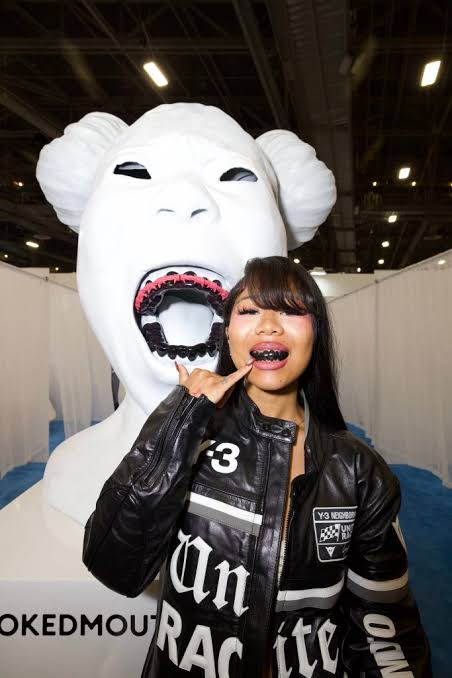 Sukii Baby. Photographer/venue unattributed; sourced via Google Images.
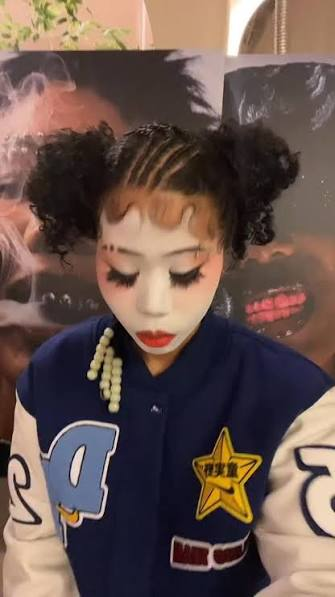 Sukii Baby, styled with white face paint echoing traditional shiro-nuri makeup. Source unattributed.
 Molly Santana. Photographer/venue unattributed; sourced via Google Images.
The trend’s most visible face was North West, daughter of Kim Kardashian and Kanye West, who debuted blacked-out teeth as part of her outfit for a Ken Carson concert in October 2025 (Stout 2025). She wore black teeth grills again during a January 26, 2026 Instagram Live with her mother, telling a viewer who questioned the look “I could take them out” — both appearances drew heavy social-media backlash, much of it aimed at Kim Kardashian rather than her then-12-year-old daughter (Qayum 2026).
Single-source framing
The specific throughline back to ohaguro — as opposed to reading “black grills” simply as a variant of existing hip-hop grill culture — rests mainly on one Bustle piece (Stout 2025); it’s the kind of trend-explainer that reaches for a tidy historical hook, and no other outlet covering the story draws the ohaguro connection independently. Worth treating as one writer’s framing rather than settled fact. It’s also worth noting that North West’s teeth are a removable grill by her own account, not a painted or dyed application — a meaningfully different technique from both ohaguro’s kanemizu dye and the FX-makeup method Bustle describes elsewhere in the same piece; press coverage tends to blur the two together under one “black teeth trend” umbrella.
Not the English “sugar teeth” story
Ohaguro is sometimes mentioned in the same breath as the English folk tale that fashionable Elizabethans deliberately blackened healthy teeth to look like they could afford sugar — but the two are unrelated. They differ in origin, chemistry, and symbolism, and ohaguro predates any significant European sugar consumption by centuries.
Contested
The English story is itself weaker than it’s usually told. Sugar-driven tooth decay among Elizabethan elites was real — court dentistry and diet accounts support that much, and it rests substantially on a single well-known account (a 1599 description of Elizabeth I by the German traveler Paul Hentzner). The stronger claim, that people cosmetically blackened healthy teeth with soot to fake sugar wealth, has thin documentary support and looks more like a popular-history embellishment than an established practice.
Terminology
- kanemizu: the iron-acetate/tannin dye solution used to blacken teeth.
- shiro-nuri: the white face powder makeup ohaguro was worn to contrast with.
- mimidarai, watashigane: dedicated basin and tray tools used to apply kanemizu.
- erikae: a geisha’s coming-of-age ceremony, one of the few contexts where ohaguro survives today.
Sources
- Stout, Emma. “Teeth Blackening Is Trending — But The History Of The Look Is Ancient.” Bustle, Oct. 24, 2025. https://www.bustle.com/beauty/teeth-blackening-trend-origin-north-west-ohaguro-opium-aesthetic
- Qayum, Mariam. “Social Media Reacts To North West’s ‘Horrendous’ Black Teeth Grills Worn On Instagram Live With Kim Kardashian.” Yahoo Entertainment, Jan. 31, 2026. https://www.yahoo.com/entertainment/celebrity/articles/social-media-reacts-north-wests-023005501.html