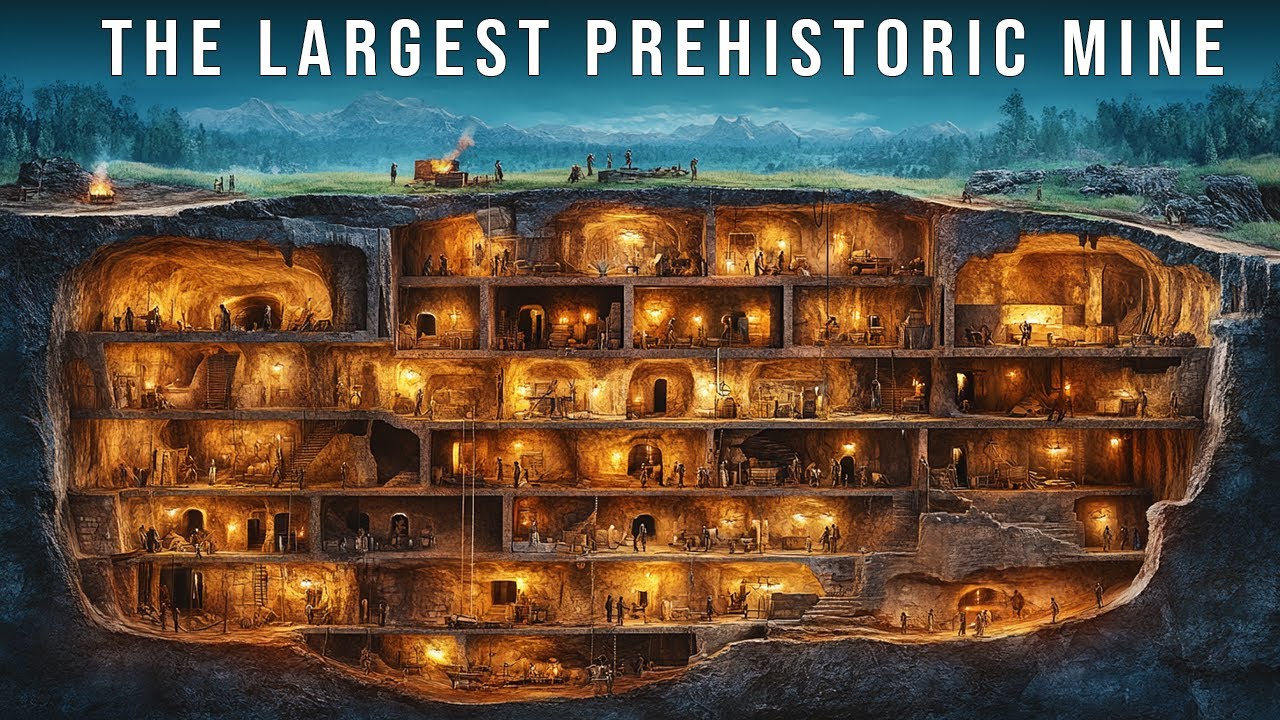
 Source: “The Largest Prehistoric Copper Mine in the World”, Dan Davis History.
Stub
Autogenerated draft, unreviewed.
Kargaly is a Bronze Age copper mining and metallurgical district in the Southern Urals of Russia, along the valley of the Kargala River (a tributary of the Ural River). Ore-bearing sandstone spread across roughly 500 square kilometers was worked from the early Bronze Age until around 1300 BC, leaving behind an estimated 35,000 surface features — shafts, drift mines, prospecting pits, craters — and hundreds of kilometers of connected underground tunnels. Estimates of total Bronze Age copper output vary by source, but even the low end places Kargaly well ahead of other well-known European copper districts of the period.
| Mining district | Region | Est. Bronze Age copper output |
|---|---|---|
| Great Orme | North Wales | ~2,000 tons |
| Eastern Alps | Central Europe | ~20,000 tons |
| Kargaly | Southern Urals | ~55,000–150,000 tons |
Contested
Figures for Kargaly’s total output vary considerably by source. Popular coverage (including the video this page is drawn from) cites up to 150,000 tons; academic estimates such as Chernykh’s excavation reports put smelted output closer to 55,000–120,000 tons, drawn from an estimated 2–5 million tons of raw ore. The wood-consumption figure below follows the same higher estimate and should be read with the same caveat.
Location and early mining
Copper deposits at Kargaly sit in sandstone beneath alluvial soils, at depths of up to 12 meters, with ore extending a further 90 meters below the bedrock surface. The blue-green color of malachite and azurite ore exposed in outcrops is thought to have guided early prospectors to the deposits, the same way it did at surface-exposed mines elsewhere in Bronze Age Europe.
The region’s first mining activity dates to the early Bronze Age. A settlement of the Repin culture (an early Yamnaya ceramic style), roughly 70 km west of the main deposits and dated to 3800–3360 BC, yielded copper ore, slag, and tools, suggesting some initial processing happened there. The Yamnaya culture — mobile pastoralists and metalworkers — worked the site more intensively after 3000 BC; a Yamnaya burial near Kargaly, radiocarbon dated to about 2900–2700 BC, held a young man buried with a copper axe and its casting mold, likely marking him as a metalworker. Yamnaya mining activity stopped after 2500 BC.
Mining resumed around 1900 BC and continued for roughly six centuries, into the mine’s main productive phase under the Srubnaya culture, steppe pastoralists with settlements across the Pontic–Caspian steppe. This phase ended by around 1300 BC.
Extraction techniques
Miners dug vertical or inclined shafts 10–12 meters deep, with hand- and footholds cut into the rock for climbing, then tunneled outward from the shafts following ore veins — sometimes down to 40 meters, with chambers up to 20 meters high where deposits were rich. The sandstone was soft enough to work with simple tools but correspondingly prone to collapse. Tunnel networks frequently interconnected into labyrinths; where deposits were poor, exploratory digging instead left the surface pitted with shallow craters.
Tools recovered from the site include antler and cattle-bone picks, cattle-scapula shovels, large stone hammers, and — in later phases — bronze picks, with tool marks still visible etched into some mine walls.
 E.N. Chernykh, 2010. CC BY-SA 3.0 / GFDL, via Wikimedia Commons.
Settlements and daily life
Around 20 settlements are linked to the Bronze Age mining operation. The most thoroughly excavated, Gorny, sits on a low hill within the mining complex and began as a scatter of seasonal pit dwellings before growing into a permanent settlement with houses, smelting facilities, and ritual areas. Excavations there recovered roughly 120,000 pottery shards (from an estimated 6,000 vessels), about 2.5 million animal bones (overwhelmingly cattle), around 4,000 copper finds — raw metal, ingots, finished tools — and 190 casting molds for axes, daggers, and picks.
Initial ore crushing and sorting took place at Gorny, but much of the ore appears to have been shipped elsewhere for smelting, likely because local fuel supply couldn’t keep pace with extraction. Smelting copper is fuel-hungry: producing 1 kg of copper required an estimated 65 kg of charcoal, and 65 kg of charcoal required around 500 kg of dry wood. Applied to the higher production estimates, that implies tens of millions of tons of wood consumed over the mine’s life — a scale of demand for which the surrounding steppe had limited local supply. Some researchers point to the resulting fuel shortage, rather than ore depletion, as a leading explanation for the mine’s eventual decline.
Gorny also shows signs of ritual practice not obviously tied to production: pits with what appear to be deliberate offerings, and stone objects interpreted as phallic symbols. Similar ritual activity is documented at other ancient mine sites and has been read as an attempt by miners to propitiate chthonic deities before going underground — a plausible response to genuinely dangerous work, though the specific religious meaning of any given deposit is necessarily speculative.
Trade and distribution
Kargaly copper was worked into tools, weapons, and ornaments, and evidence points to long-distance export well beyond the Southern Urals. The clearest support for this comes from lead-isotope analysis of early oxhide ingots (copper cast in a distinctive shape resembling a stretched animal hide) found on Minoan Crete and dated to roughly 1550–1450 BC: their isotopic signature matches Southern Ural ore rather than Cyprus, the source of essentially all oxhide ingots after 1400 BC (Powell, Barjamovic & Pulak 2024). The proposed route runs from the Urals around or across the Caucasus, through the Mitanni kingdom in northern Mesopotamia, and on to Cyprus or via Anatolia to Crete.
Contested
The Ural-origin attribution for these early Cretan ingots is a 2024 result, not long-settled consensus — it overturns a prior default assumption that all Bronze Age Mediterranean oxhide ingots trace to Cyprus. Lead-isotope provenance work is powerful but not unimpeachable: ore fields in different regions can have overlapping isotopic signatures, and the method identifies the geological source of the copper, not necessarily the specific historical trade route it traveled.
Decline
Mining activity at Kargaly ended by around 1300 BC, and the Srubnaya culture itself declined by about 1200 BC. Proposed explanations include exhaustion of the local fuel supply, broader climatic disruption, or both — set against the backdrop of the Late Bronze Age Collapse, a period of widespread trade disruption and migration across the Old World. The site was left largely undisturbed for roughly 3,000 years until Russian industrial prospectors reopened it in the 18th and 19th centuries, extracting an additional estimated 130,000 tons of copper — at its peak supplying around a quarter of the Russian Empire’s copper.
 E.N. Chernykh, 1995. CC BY-SA 3.0 / GFDL, via Wikimedia Commons.
Terminology
- malachite, azurite: blue-green copper ores, useful for surface prospecting because of their distinctive color.
- alluvial soil: soil deposited by flowing water, here overlying the ore-bearing sandstone.
- drift mine: a horizontal or gently inclined tunnel dug into a hillside or vein to reach ore, as opposed to a vertical shaft.
- smelting: extracting metal from ore by heating it, typically with a reducing agent like charcoal.
- oxhide ingot: a Bronze Age copper ingot cast in a shape resembling a stretched animal hide, common in Mediterranean trade.
- lead isotope ratio: the relative abundance of lead isotopes in an ore or artifact, used as a geological “fingerprint” to trace a metal object back to its ore source.
- chthonic: relating to deities or spirits of the underworld.
Sources
- Chernykh, E.N. (ed.), Kargaly, Vols. I–V (Moscow: Institute of Archaeology RAS / Yazyki Slavianskoi Kultury, 2002–2010).
- Chernykh, E.N. et al., “Ecological Catastrophes in the Steppe? Landscape Archaeology at the Mining and Metallurgical Complex of Kargaly.”
- Powell, W., Barjamovic, G. & Pulak, C. (2024). “Copper for the Early Oxhide Ingots Traced to the South Urals.” Journal of Archaeological Science: Reports, 56, 104583.
- O’Brien, W. (2015). Prehistoric Copper Mining in Europe, 5500–500 BC. Oxford University Press.